

Christopher Nolan’s Odyssey
The acclaimed director gives us a surprisingly modern Bronze Age warrior

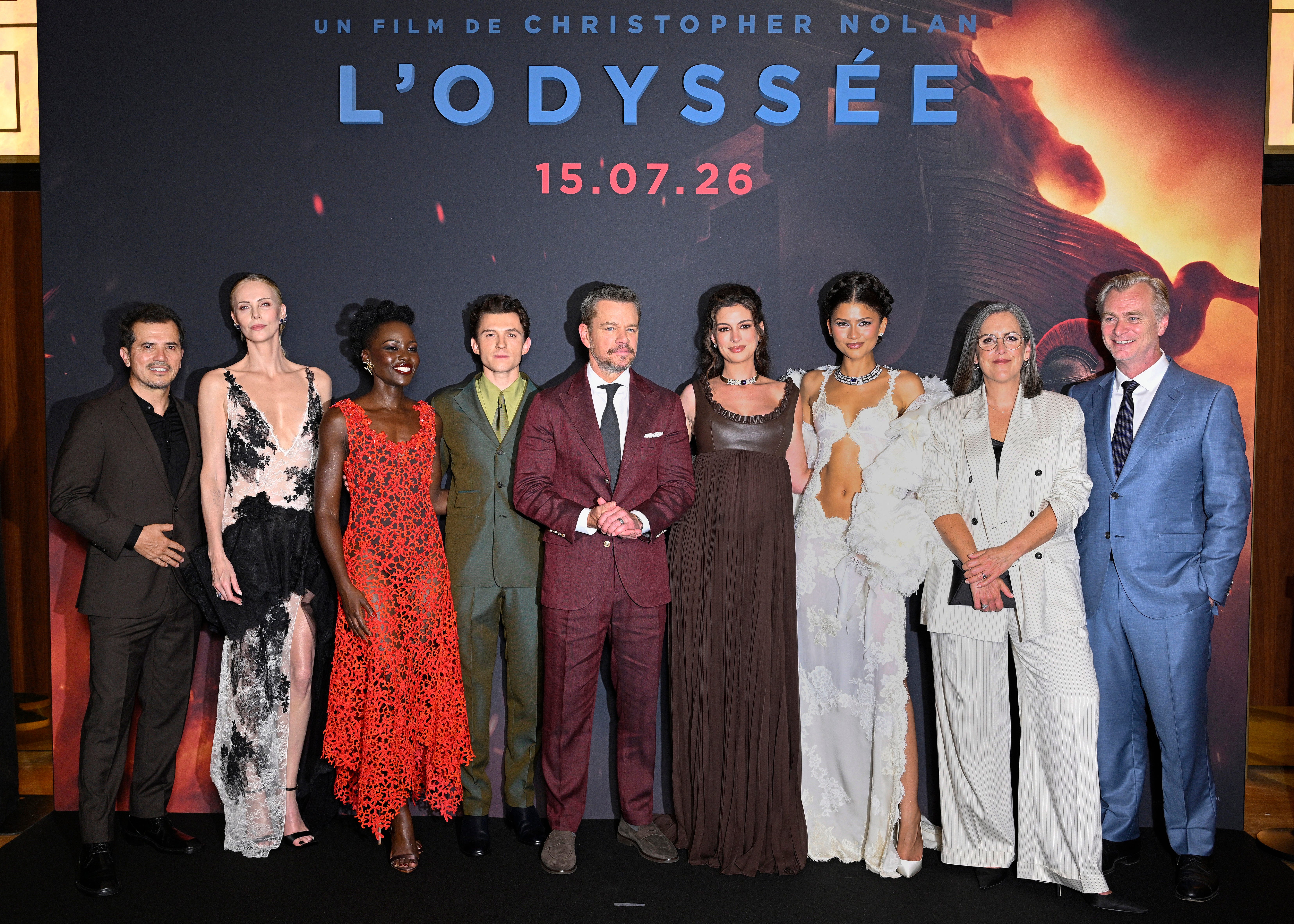
In the 2023 post I wrote about Christopher Nolan’s Oppenheimer, I began by explaining my ambivalent judgment of his work as a filmmaker. Though I recognized his virtues, including wild-eyed ambition that sometimes crossed the line into an outright audacity to “make Big Statements while also earning hundreds of millions of dollars at the box office,” I also admitted that I often found his films “overly plotted, tonally bombastic, and tangled up … in conceptually muddled pretensions.” Despite this, I liked Oppenheimer quite a lot, including Nolan’s own ambivalence about his subject’s scientific/technological and moral legacy.
Three years later, almost to the day, Nolan is back with his latest epic, an adaptation of Homer’s The Odyssey that has been stirring controversy for months based on pure speculation by very online right-wing “influencers.” These anticipatory critics objected to Nolan’s supposed “wokeness” in casting the black actress Lupita Nyong’o as Helen of Troy and trans actor Elliot Page as a Greek soldier. These were sure signs that Nolan would be pushing a left-wing agenda with the film in order to win praise and awards from the corrupt, dishonest Hollywood establishment, and thereby doing severe damage to one of the foundational works of Western Civilization. It was in proud defense of the latter that most of these loudmouths took their stand.
Now the film is out, it’s a massive commercial and critical success, but many of these same critics (as well as some others) on the right nonetheless feel vindicated. The problem, it turns out, is much vaster than casting decisions. The movie, we’re told, is a top-to-bottom betrayal of its source material, giving us an areligious or secular retelling of the story in which the protagonist (Odysseus) is a guilt-ridden, mopey soldier suffering from PTSD who lacks the character’s brash, crafty-clever comedic charm in the epic poem. Many of the set pieces of the story (encounters with the cyclops; Circe; Calypso; the Sirens) are visually compelling, but they advance an outlook that can only be described as a left-wing critique of Bronze Age polytheism, masculinity, and heroism.
What makes this response interesting, at least to me, is that it’s about half right. As I will explain, I quite liked the film—maybe more than any previous Nolan movie. That’s mainly because when directing his own scripts, Nolan always works in an epic mode of filmmaking, and this is the first time that instinct or preference perfectly matches his material. This is an epic cinematic telling of an epic story, so, for once, the bombast works and feels fitting, as opposed to feeling forced or imposed on material that can’t possibly carry the weight. Yes, I’m afraid that cannot help being the case for a series of movies about a billionaire vigilante who fights sociopathic villains while wearing a bat costume.
Though the right-wing critics nonetheless have a point. As Daniel Mendelsohn, a very knowledgeable critic without an ideological axe to grind, confirms, this is very much a drastic reworking of The Odyssey that breaks rather broadly from the moral and thematic approach of the original. I nonetheless strongly disagree with the right’s suggestion that the film advances any kind of politicized—let alone a “left-wing”—message. It is, rather, a Christianized (or perhaps more accurately, a post-Christian liberal humanist) reimagining of the classic saga. That certainly isn’t the only way to bring Homer to a modern (and modern American) audience in 2026. But it’s an artistically defensible one to which Nolan firmly committed in developing the project. I think the decision works and makes for an emotionally powerful and resonant variation on a familiar story.
(I suppose I should warn readers that what follows will contain spoilers about the movie—though less about what I hope and assume are well-known plot points than about the choices Nolan has made in dramatizing them.)
