


To give you a sense of where I’m coming from on this topic: I’m the guy who once wrote a controversial column with the following lede:
“Star Wars? Meh.”
This was back in 2015, when The Force Awakens had just been released. It was the first sequel or prequel of the original films to appear in theaters in ten years, and Star Wars mania was everywhere.
I wasn’t impressed. I confessed that I’d loved the original two films (Star Wars, now known as A New Hope, and The Empire Strikes Back) when they were first released—respectively, in 1977, when I was 7 years old, and 1980, when I was 10. But by the release of the third film, Return of the Jedi, in 1983, when I had just become a teenager, the magic had faded.
Wooden dialogue, cardboard acting, hokey humor, and a grade-school Manichean/Gnostic metaphysics in which characters choose between darkness and light, bodies are dismissed as “crude matter,” and dead friends and teachers stand around glowing and offering portentous advice — none of that bothered the 7-year-old me. But now it began to seem silly, childish.
And that was long before the release of the prequels, the first two of which were far worse than the original three movies—indeed, two of the worst big-budget Hollywood movies I’ve ever seen. By then I was in my late 20s and early 30s and thoroughly uninterested in Star Wars for anything more than a very occasional nostalgia trip. Hence my snarky comment ten years ago, in the midst of a social-media-fueled frenzy of hype for the first of the (thoroughly mediocre) J. J. Abrams sequels, about the childishness of American (and through it, global) popular culture.
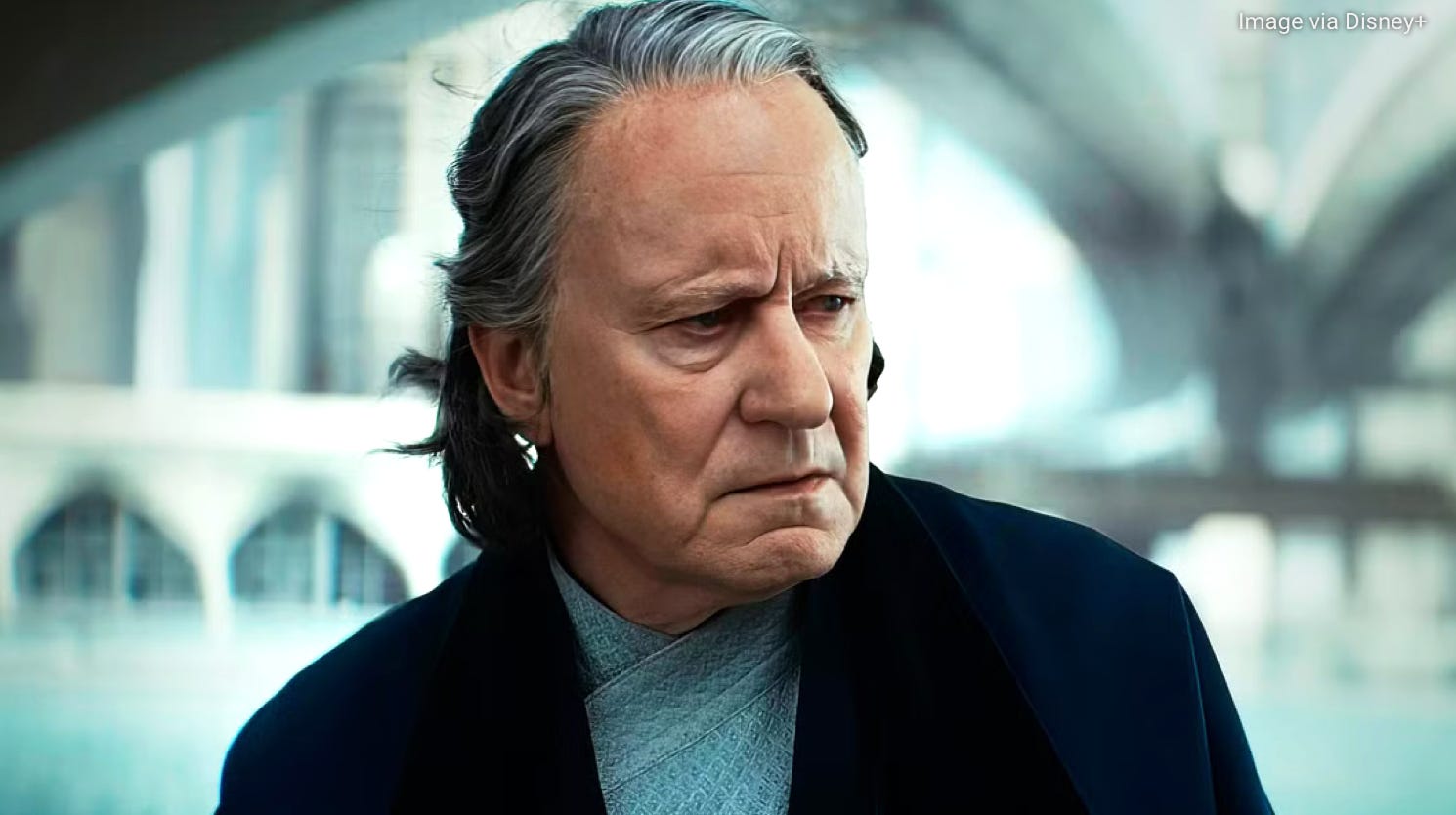
I recount all of this in order to establish myself as a longstanding Star Wars skeptic so that readers will take me seriously when I confirm the widespread assessment of the latest entry in what is now a vast franchise of lucrative spin-offs from the original films. I’m talking about the television show Andor, which recently wrapped up its two-season run on Disney+. One of its stars, Stellan Skarsgård, made headlines around the time the show’s first season wrapped up by calling it “Star Wars for grownups.” As a guy who considered that possibility an oxymoron a decade ago, I’d like to go on the record as saying that’s exactly what Andor is: The first effort to contribute to the Star Wars universe that rises above the considerable limits of the source material to approach genuine artistic excellence.
Keep reading with a 7-day free trial
Subscribe to Notes from the Middleground to keep reading this post and get 7 days of free access to the full post archives.